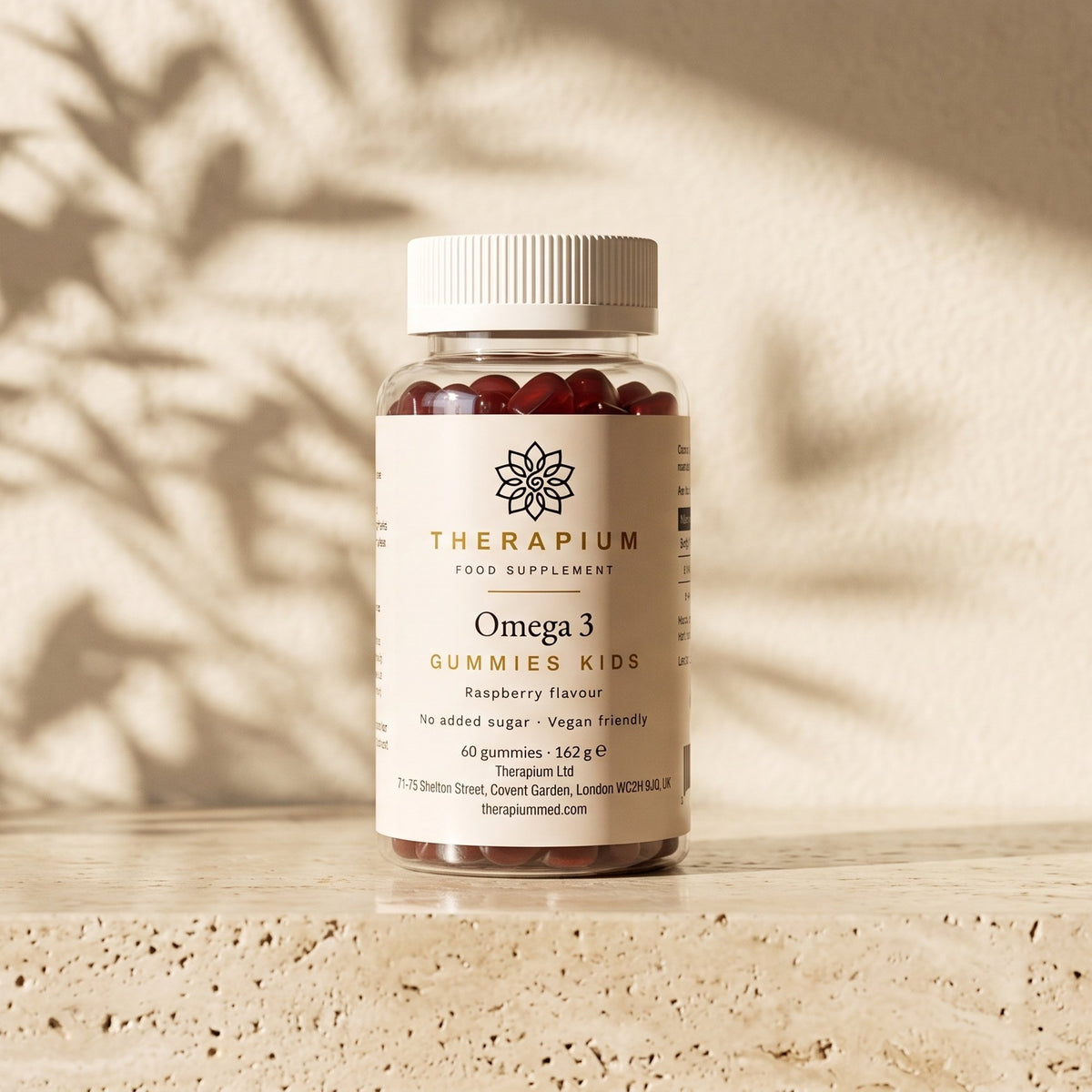
Therapium Omega 3 Gummies Kids — 60 vegan gummies, 250 mg omega-3 from algae
250 mg omega-3 per 2 gummies · DHA 187.5 mg · EPA 62.5 mg · 60 vegan gummies · raspberry
Sixty raspberry gummies with omega-3 from algae, not fish.
The DHA and EPA here come from Schizochytrium sp., a marine microalga grown in tanks — the same source the fish themselves get it from. No fish, no gelatine, no fish aftertaste. Two gummies is the recommended daily serving.
How to use
- Two gummies a day, chewed.
- Any time of day, with or without food.
What's in the jar
60 gummies — 30 daily servings at two a day.
Key ingredients
- Algal oil (Schizochytrium sp.) — the DHA and EPA, from a vegan marine source.
- High-oleic sunflower oil — the carrier.
- Pectin — sets the gummy, so no gelatine is needed.
- Carrot and blackcurrant — the colour comes from food, not dyes.
Flavour
Raspberry, with a natural lemon note. Sweetened with maltitol syrup and maltitol.
Good to know
- Vegan — set with pectin rather than gelatine.
- Contains maltitol. Excessive consumption may produce a laxative effect.
- The amount of DHA and EPA per serving is printed on the jar label.
Full ingredients
Sweetener: maltitol syrup, water, sweetener: maltitol, DHA- and EPA-rich oil from the microalga Schizochytrium sp., high-oleic sunflower oil, antioxidants: mixed tocopherols, rosemary extract, ascorbyl palmitate, gelling agent: pectin, acidity regulator: citric acid, natural flavourings, acidity regulator: potassium sodium tartrate, natural lemon flavouring, colours (carrot, blackcurrant), emulsifier: sunflower lecithin, acidity regulator: sodium citrate, glazing agents (vegetable oil, carnauba wax).
Food supplement. Not a substitute for a varied and balanced diet and a healthy lifestyle. Do not exceed the recommended daily dose. Keep out of the reach of small children.
Therapium Ltd, company number 16471805 · 71–75 Shelton Street, Covent Garden, London WC2H 9JQ, United Kingdom
Free shipping over €89, across Europe and the UK · €4.90 in Romania, €6.90 elsewhere · 14-day right of withdrawal and a 60-day guarantee · Batch 6146
References are informational and do not constitute health claims.
Sixty gummies, algae instead of fish, one certificate
Everything below is on the label or in a document we hold. Where there is a number, it is printed. Where there is a name, it belongs to a company or a laboratory you can look up.

Two gummies a day, and the omega-3 comes from algae
The DHA and EPA in these gummies come from Schizochytrium sp., a marine microalga grown in tanks — the same organism the fish get their omega-3 from, without the fish in between. There is no fish oil, no fish gelatine and no fish aftertaste to hide, which is why the jar can say vegan on the front. Two gummies after a meal is the daily dose; the jar holds sixty, so thirty days.
60 gummies · 162 g · two a day · 30 days
250 milligrams of omega-3, and which claim that does and does not earn
Two gummies give 250 mg of omega-3 fatty acids: 187.5 mg of DHA and 62.5 mg of EPA. That is exactly the daily intake at which the EU allows one sentence to be printed — DHA and EPA contribute to the normal function of the heart. The two other omega-3 sentences in the Register, about brain function and vision, require 250 mg of DHA on its own; two gummies carry 187.5 mg, so we do not print them. The numbers are on the side of the jar, in the same order.
Per 2 gummies — omega-3 250 mg · DHA 187.5 mg · EPA 62.5 mg


No added sugar, and what makes it sweet instead
The gummy is sweetened with maltitol syrup and maltitol, two sugar alcohols, which is why the label can say no added sugar and why it also has to say that excessive consumption may produce laxative effects. It is set with pectin from fruit rather than gelatine, coloured with carrot and blackcurrant rather than dyes, and flavoured with natural raspberry and lemon. The full ingredient list is on the label and in the Ingredients tab above; nothing on it needs a footnote.
Sweeteners: maltitol syrup, maltitol · gelling agent: pectin · colours: carrot, blackcurrant
Made in Germany, certified by a laboratory with a name
Brands on Demand UG in Berlin makes the gummies under HACCP certified conditions. Lot 6146, best before 11/2027, was tested by UBF Untersuchungs- und Forschungslaboratorium GmbH in Altlandsberg — heavy metals (lead, mercury, cadmium, arsenic) and microbiology (total plate count, yeast, mould, E. coli, Enterobacteriaceae, salmonella) — and on 13 July 2026 the laboratory issued a free sale certificate against testing report 202606260700, confirming conformity with Regulation (EU) 2023/915 on contaminants and Regulation (EC) No 178/2002. The lot number and the best-before date are printed on the base of the jar. Ask us about the lot you received and we will tell you what its certificate says.
UBF GmbH, Altlandsberg · report 202606260700 · lot 6146
The omega-3 statement above is quoted in the wording authorised in the EU Register of nutrition and health claims and applies at the daily dose of two gummies. A food supplement is not a substitute for a varied and balanced diet or for a healthy lifestyle.
The whole case for the price is one division
Two gummies are a dose. The jar holds thirty of those. Divide the price by that number and you have what a day costs. We would rather show the working than describe it.
€37,99 ÷ 60 gummies × 2 a day = 126.6 cents a day
Two gummies a day makes that 30 days — one month from a single jar. Read it as arithmetic rather than as a promise: the best-before date on the jar governs, and two children in one house halve the number.
Counted per gummy instead — 60 in the jar — it is 63.3 cents apiece. Same money, same jar; the only question is whether you count gummies or days.
Figures rounded to one decimal. Thirty days assumes the daily dose of two gummies from the age of four.
Next to a supermarket kids' omega-3 gummy
The right-hand column is a category, not a company. It describes what is usually printed on a supermarket children's omega-3 gummy, so that every line can be checked against a label you may already have at home.
| What you can check | This jar | A typical supermarket kids' omega-3 gummy |
|---|---|---|
| Omega-3 per daily dose | 250 mg — DHA 187.5 mg, EPA 62.5 mg, from algal oil | Often 50–150 mg, and the split between DHA and EPA is not always printed |
| Where the omega-3 comes from | Schizochytrium sp. microalgae grown in tanks — no fish | Usually fish oil; the fish species is rarely named |
| Sugar | No added sugar; sweetened with maltitol syrup and maltitol | Glucose syrup and sugar are commonly the first two ingredients |
| What sets the gummy | Pectin — vegan | Usually gelatine, from pork, beef or fish |
| Colour | Carrot and blackcurrant | Often colourings listed by name or E-number |
| Doses per pack | 30 — sixty gummies at two a day | Commonly 30 to 60 gummies at one or two a day |
| Cost per day | About 66.6 cents | Divide the pack price by the number of days — the figure is rarely printed |
| Lot certificate | Done, with the laboratory, the report number and the lot all named: UBF GmbH, Altlandsberg, report 202606260700, lot 6146 | Not usually printed; ask the seller for the certificate of the lot you were sent |
| Country of manufacture | Germany — HACCP certified conditions | Often given only as “made in the EU” |
No brand is named here because no brand was tested. The right-hand column is a general description of the category drawn from publicly printed labels, and individual products differ — read the one in front of you. Everything in the middle column is on our label or in a document we hold and will quote to you.
The questions people actually ask
Short answers with the numbers in them. If what you need is not here, ask us before you buy rather than after.
Answers refer to the lot named in them. The codes printed on the jar you receive are the ones that count.
Why algae rather than fish oil?
Fish do not make omega-3; they eat the algae that do. Schizochytrium sp. is that alga, grown in closed tanks, and its oil carries the same DHA and EPA without the fish in between. For a gummy that also means no fish gelatine and no fish taste to cover with sugar.
Two gummies give 250 mg of omega-3 fatty acids: 187.5 mg DHA and 62.5 mg EPA. The figures are on the side of the jar.
What does 250 mg actually do?
The only thing we will say is the sentence the EU allows at this dose: DHA and EPA contribute to the normal function of the heart. The Register attaches that wording to a daily intake of 250 mg of EPA and DHA, which is what two gummies carry.
The two other omega-3 sentences — about normal brain function and normal vision — require 250 mg of DHA on its own. Two gummies contain 187.5 mg, so you will not find those sentences on our label or on this page.
From what age?
From four years, and under adult supervision. Two gummies a day after a meal, chewed; do not exceed that.
For younger children, or if your child takes medication or is under medical care, ask a doctor or pharmacist first. This is a food supplement, and we are not going to guess about a child we have not met.
Is there sugar in it?
No added sugar. The sweetness comes from maltitol syrup and maltitol, two sugar alcohols. They are the reason the label also carries the sentence excessive consumption may produce laxative effects — that is the legal wording for polyols, and two gummies a day are well inside normal use.
The gummy is set with pectin, coloured with carrot and blackcurrant, and flavoured with natural raspberry and lemon.
Is it really vegan?
Yes. The omega-3 is algal oil, the gummy is set with pectin instead of gelatine, and the glazing is sunflower oil and carnauba wax. The full list is in the Ingredients tab and on the label; nothing on it comes from an animal.
It also contains none of the allergens that must be declared under Annex II of Regulation (EU) No 1169/2011, and it is non-GMO.
How long does one jar last?
Sixty gummies at two a day is thirty days — one child, one month.
The best-before date on the base of the jar governs. The current lot, 6146, is best before 11/2027.
What does the certificate actually cover?
Lot 6146 was tested by UBF Untersuchungs- und Forschungslaboratorium GmbH in Altlandsberg for heavy metals — lead, mercury, cadmium, arsenic — and microbiology — total plate count, yeast, mould, E. coli, Enterobacteriaceae, salmonella. On 13 July 2026 the laboratory issued a free sale certificate against testing report 202606260700, confirming the lot conforms to Regulation (EU) 2023/915 on contaminants and Regulation (EC) No 178/2002.
That is a named laboratory, a named report number and a named lot. Ask us about the lot printed on your jar and we will tell you what its certificate says.
How do I know the jar I receive is the real thing?
Check the codes against the jar. EAN 4262487491252, SKU C2B-KIDS-OMG3-GUM, made by Brands on Demand UG in Berlin under HACCP certified conditions. Lot 6146 is best before 11/2027.
If what is printed on your jar does not match what is printed here, tell us and do not use it.
Where do you ship, and what does it cost?
Twenty-nine countries: twenty-six EU member states — every one except Cyprus — plus the United Kingdom, Switzerland and Norway. Delivery is €4.90 in Romania and €6.90 to every other destination, and free on orders of €89 or more.
We do not ship worldwide. If your country is not on the list at checkout, we cannot reach you yet — that is a limit, not a strategy.


